Ereshkigal / Queen of the Great Below
Queen of the Great Below, ruler of the land of the dead
Ereshkigal was the queen of the underworld — the Great Below, the land from which no one returns. She ruled the dead in her dark palace, Ganzir, and even the greatest gods feared her judgment. Her sister was Ishtar, queen of heaven; she was the queen of everything underneath.
How they were born
Ereshkigal was the daughter of Nanna, the moon god, and his wife Ningal, and the sister of the sun god Utu and the goddess Inanna. In one story, she was given the underworld as her share of the world, while her brother and sister got the sky and the earth. In another, she was carried off by the dragon Kur to be queen of the dead. Either way, she became the ruler of Kur — the Great Below — a vast, dark cavern under the earth, where the dead live on dust and clay, and where her word is law.
The greatest stories
Queen of the Great Below
The underworld was called Kur, or Irkalla, or the Great Below, and it was a dark and dusty place with no light and no way out. The dead arrived naked, ate clay, and drank from muddy water. Ereshkigal ruled it from her palace, Ganzir, with her gatekeeper Neti, who guarded the seven gates, and her vizier Namtar, the god of fate and plague, who carried out her commands. She did not punish the dead — there was no heaven or hell in Mesopotamia, only the Great Below, and Ereshkigal was its queen, fair and terrible and final.
Inanna's Descent
One day her sister Inanna came down to the underworld, dressed in all her finery, to attend the funeral of Ereshkigal's husband Gugalanna, the Bull of Heaven. But Ereshkigal was not fooled: at each of the seven gates, Neti stripped Inanna of a garment, until she stood naked before the throne. The judges of the dead found her guilty, and Ereshkigal fixed her with the eye of death and hung her body on a hook. Only when Enki sent his small creatures with the food and water of life did Inanna revive — and Ereshkigal let her go, on one condition: someone had to take her place.
Nergal and Ereshkigal
The gods held a feast in heaven, and Ereshkigal could not leave her kingdom to attend, so she sent her messenger Namtar in her place. Every god stood up to honour him — except Nergal, the god of war, who stayed in his seat. Furious, Ereshkigal demanded that Nergal be sent down to answer for the insult. He came down with fourteen demons, dragged her from her throne by the hair, and raised his axe to kill her. She begged for her life and offered him her throne, her kingdom, and herself. Nergal accepted — and became the king of the dead beside her.
Family & connections
Symbol, animal & weapon
Fun facts
- Her name means 'Queen of the Great Below' — and the Great Below was so vast that the Sumerians just called it 'the Great Place'.
- The dead in her kingdom ate dust and clay, and drank muddy water — there were no feasts in the Mesopotamian afterlife.
- Her gatekeeper Neti guarded seven gates, and every visitor had to give up something at each one.
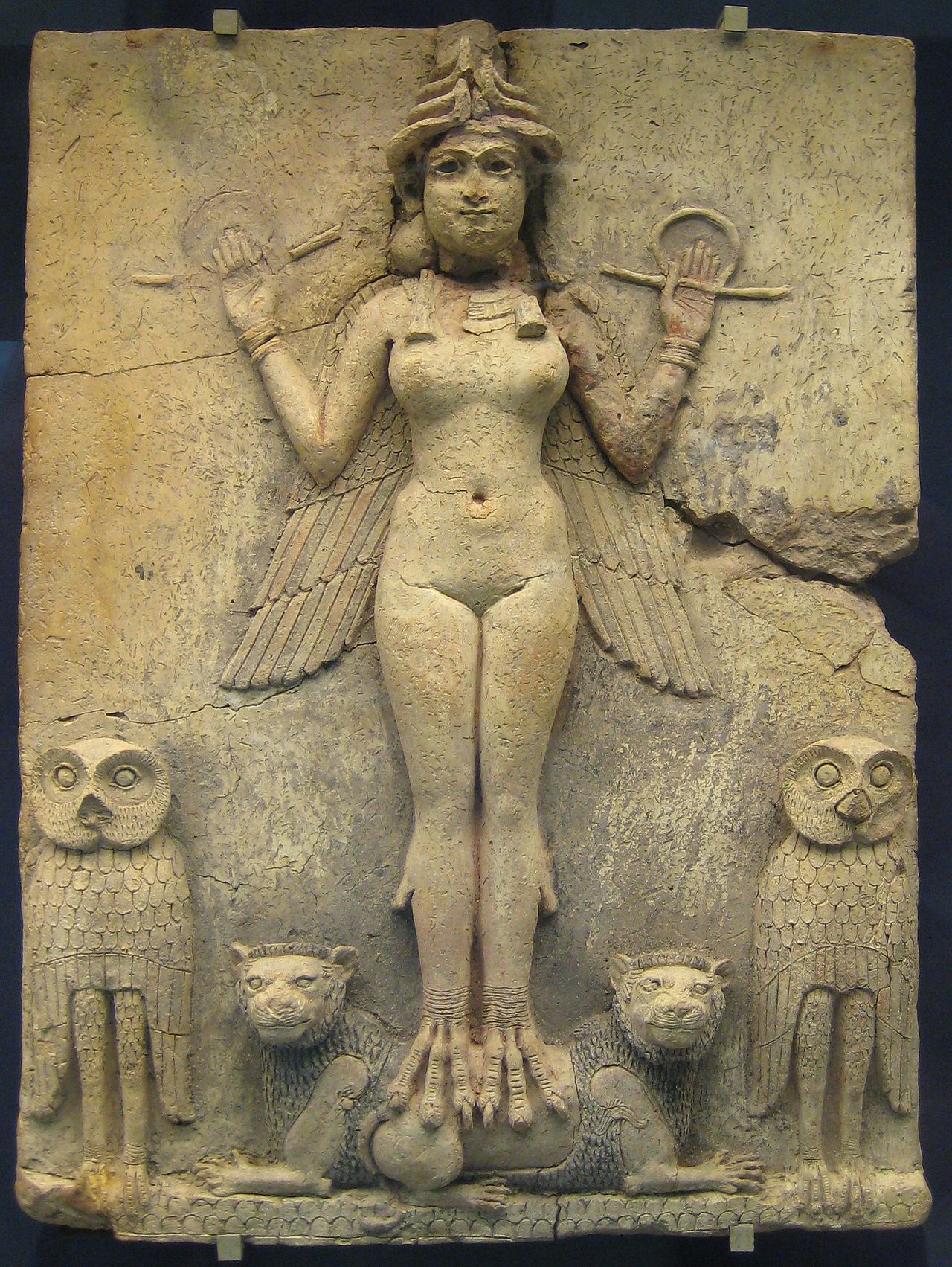
- The famous Burney Relief — the 'Queen of the Night' — may show Ereshkigal, though scholars still argue about whether it is her, Ishtar, or someone else.
Gallery — sculpture & art


