Huitzilopochtli / Hummingbird of the South
God of war and the sun, patron of the Mexica
Huitzilopochtli — the Hummingbird of the South — was the god of war and the sun, and the patron god of the Mexica, the people we call the Aztecs. They believed he led them to a new home and that his strength kept the sun rising each morning. His temple stood at the heart of the city, Tenochtitlan.
How they were born
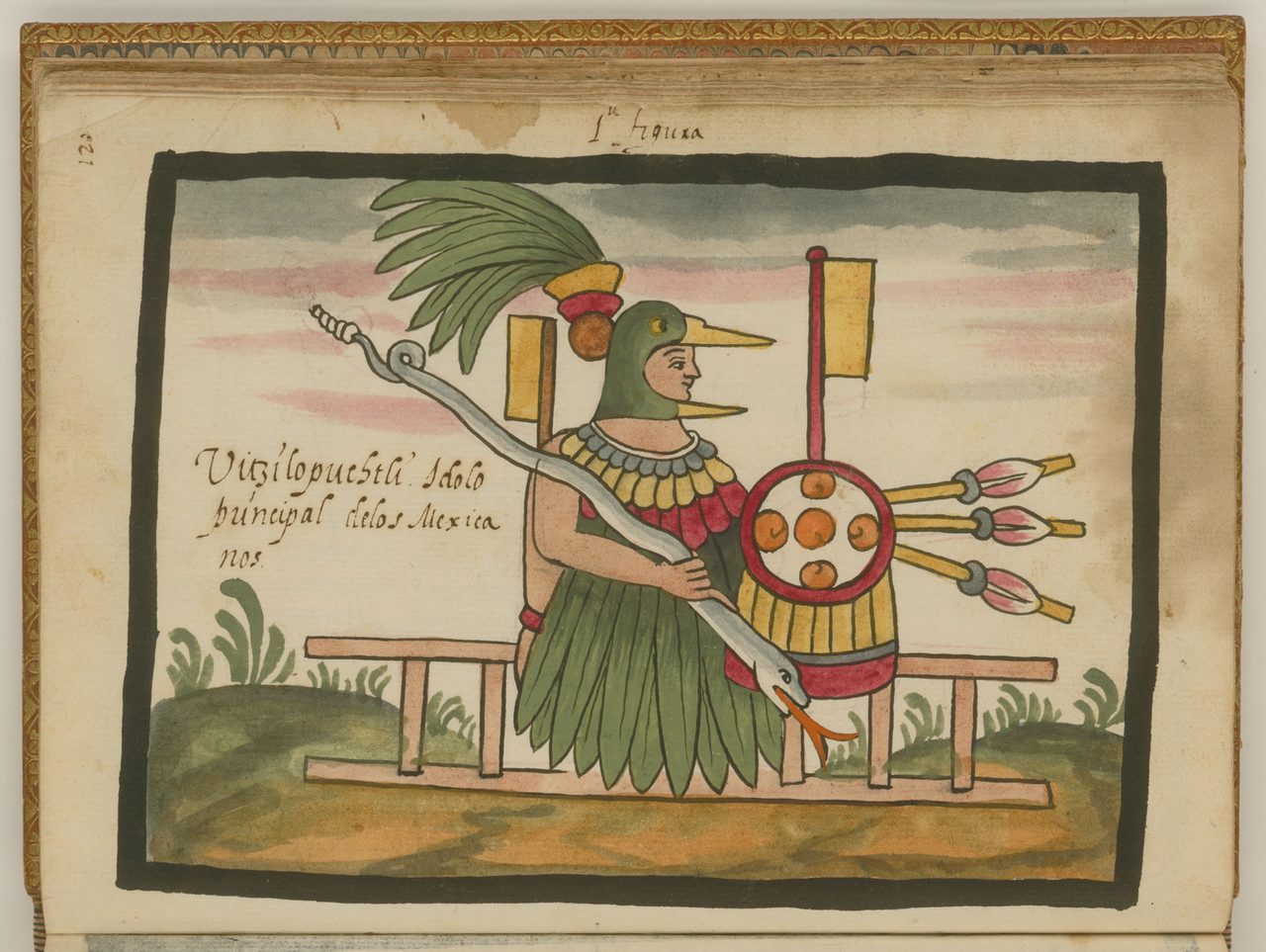
Huitzilopochtli was born on Coatepec, the Serpent Mountain, in a story the Aztecs told again and again. His mother, the earth goddess Coatlicue, was sweeping the temple on the mountain when a ball of soft feathers drifted down from the sky. She tucked it into her dress, and at once she was with child. Her daughter Coyolxauhqui and her four hundred sons, the Centzon Huitznahua, were furious at what they saw as their mother's shame, and they climbed the mountain with weapons to kill her. But before they could reach her, Huitzilopochtli burst from the womb fully grown and fully armed, with a shield, darts, and the blazing fire serpent Xiuhcoatl.
The greatest stories
The Battle on Serpent Mountain
As Coyolxauhqui led her brothers up Coatepec, Huitzilopochtli was born in a flash of light, dressed for war and painted blue. He snatched up the fire serpent Xiuhcoatl and struck his sister down with a single blow, cutting off her head. Her body tumbled down the mountain and broke apart on the rocks below. Then he turned on his four hundred brothers and chased them down the slope, scattering them across the sky. The Aztecs said this was the story of every sunrise: Huitzilopochtli was the sun, Coyolxauhqui was the moon, and his brothers were the stars, whom he defeats each morning so the day can begin.
The Eagle on the Cactus
Long before they built Tenochtitlan, the Mexica were wanderers who had left their homeland of Aztlan, far to the north. Huitzilopochtli spoke to their priests and promised to lead them to a new home, where they would see an eagle perched on a prickly pear cactus, growing from a stone in the middle of a lake. For years they travelled, carrying his sacred image with them, until at last, in the year 1325, they reached Lake Texcoco and saw the sign: an eagle on a cactus, holding a snake in its beak. There, on a small island in the lake, they founded Tenochtitlan, the city that would become the capital of their empire. The eagle and cactus appear on the flag of Mexico to this day.
The Sun Must Be Fed
The Mexica believed the world had already ended four times, and that the sun of the Fifth Sun — our own age — needed strength to keep moving across the sky. Huitzilopochtli was the sun, and every day he had to fight his way past the darkness and the stars. If he ever grew weak, the Aztecs feared the sun would stop, the sky would fall, and the world would end in darkness. So they made offerings to feed him, and their warriors fought to bring captives for the rites at his temple. War, they believed, was not only about land or power — it was the work of keeping the sun alive, and Huitzilopochtli was the warrior who fought that battle every single day.
The Temple That Was a Mountain
The Mexica built their greatest temple, the Templo Mayor, as a copy of Coatepec, the mountain where their god was born. On top stood two shrines: Huitzilopochtli's on the south side, and the rain god Tlaloc's on the north. At the foot of Huitzilopochtli's stairway lay a great round stone carved with the broken body of Coyolxauhqui, exactly where she had fallen in the myth. For centuries the temple lay buried under Mexico City, until in 1978 workmen digging for electric cables struck the Coyolxauhqui stone. Archaeologists then uncovered the ruins of the Templo Mayor, and the old story of the battle on Serpent Mountain was found carved in stone.
Family & connections
Symbol, animal & weapon
Fun facts
- His name means “Hummingbird of the South” in Nahuatl — huitzilin is a hummingbird, and the south was his direction.
- The Mexica believed warriors who died in battle flew beside the sun and returned to earth as hummingbirds and butterflies.
- His sacred image was made of amaranth-seed dough mixed with honey, and during the festival of Panquetzaliztli it was broken into pieces and shared among the people.
- His shrine stood on the south side of the Templo Mayor, beside the shrine of Tlaloc, god of rain, on the north side.
- The great Coyolxauhqui stone, found by workmen in Mexico City in 1978, led archaeologists to the buried ruins of the Templo Mayor.
Gallery — sculpture & art


