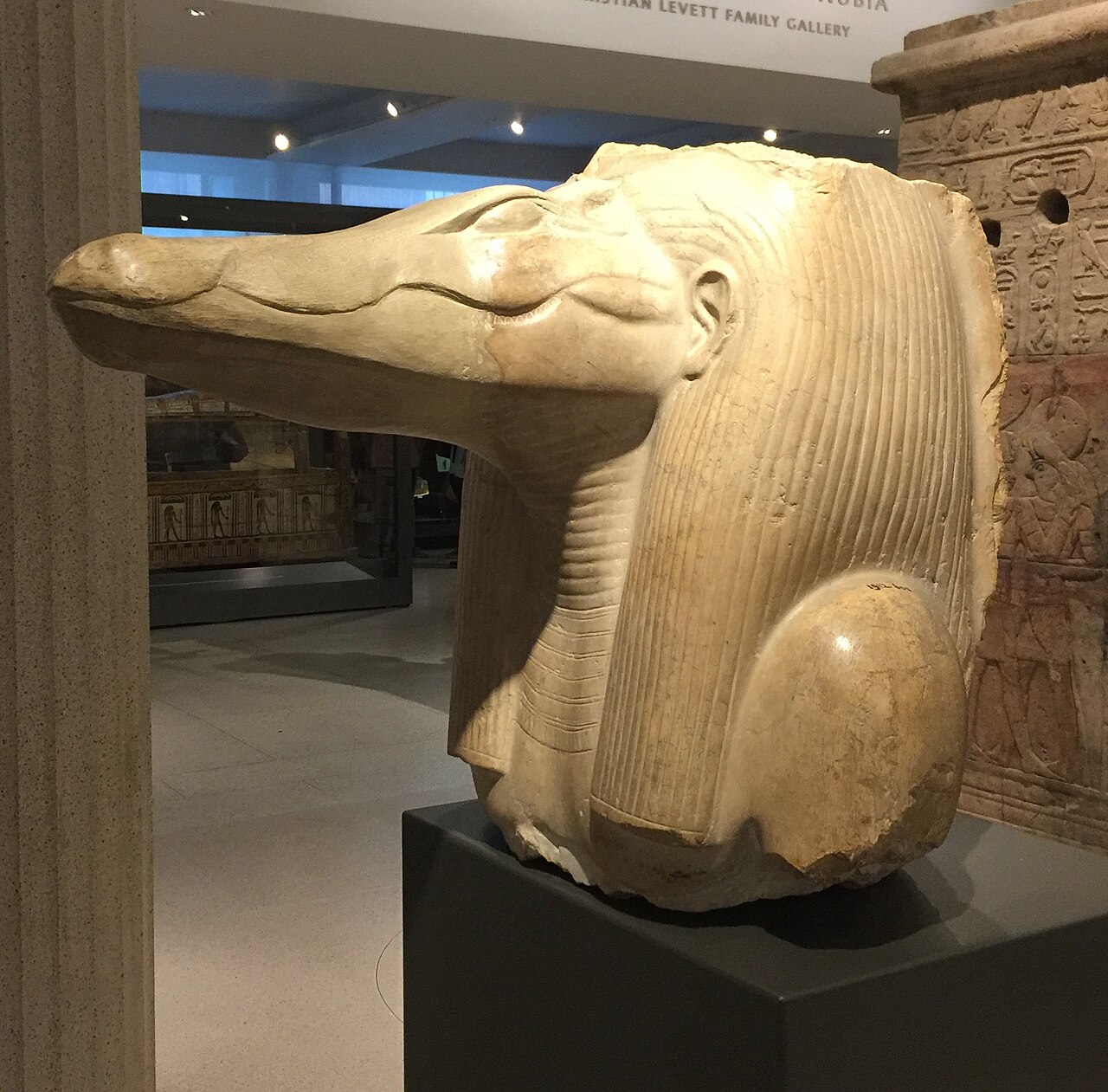
Sobek / Suchos
Crocodile god of the Nile, fertility, and pharaonic power
Sobek was the crocodile god of the Nile — feared for his teeth, loved for the flood. One of the oldest gods in Egypt, named in the Pyramid Texts four thousand years ago, he ruled the waters that made the desert bloom. At his temples, priests kept live sacred crocodiles adorned with gold, and thousands of mummified crocodiles were buried in his honor.

How they were born
Sobek was among the first gods, named in the Pyramid Texts, the oldest religious writings in the world. The stories of his birth vary: some say he was the son of Neith, the great mother goddess of war and weaving; others say he rose from the dark primeval waters of Nun, the very first creature to stir in the chaos, and that from his body the world itself was made. In the Faiyum, the fertile oasis west of the Nile, he was worshipped as a creator god — Sobek-Ra, the crocodile who rose from the waters and made the sun.
The greatest stories
Lord of the Nile
The Nile was Egypt's life, and its crocodiles were its terror — and both belonged to Sobek. Egyptians believed he controlled the flood that watered the fields, and they made offerings so he would send a good inundation and keep the crocodiles from the fishermen and the children bathing at the banks. He was both the danger of the river and its blessing: the god you feared and thanked in the same breath. Each year the river rose and flooded the fields, leaving behind the rich black silt in which the crops grew — and the Egyptians thanked Sobek for the flood, even as they feared the crocodiles that came with it. Offerings were left at the riverbank, and fishermen and children were warned to respect the water. Sobek's great temples stood at Kom Ombo and in the Faiyum, where the river met the desert.
Petsuchos, the Living God
At Crocodilopolis in the Faiyum, the priests kept a live sacred crocodile called Petsuchos — 'He Who Belongs to Suchos' — in a temple lake. It was adorned with gold earrings and bracelets, fed the finest meat and cakes, and when it died it was mummified with full honors and a successor was chosen. Visitors came from all over Egypt to see the living god, and the Greek historian Herodotus wrote of it with wonder. The sacred crocodile lived in a temple lake, adorned with gold earrings and bracelets, and fed the finest meat, cakes, and wine by the priests. When it died, it was mummified with full honors and buried in a special tomb, and a new crocodile was chosen to take its place. Herodotus, who visited Egypt in the fifth century BCE, wrote of the pampered creature with amazement.
The Double Temple of Kom Ombo
At Kom Ombo, on a bend of the Nile, stands a temple unlike any other: it is a double temple, perfectly symmetrical, with two sanctuaries side by side — one for Sobek, the crocodile, and one for Haroeris, the falcon god Horus the Elder. Two gods, two courts, two sets of everything, sharing a single building. Behind it lies the Crocodile Museum, filled with mummified crocodiles found in the nearby tombs, some of them enormous. The temple is perfectly symmetrical: two entrances, two halls, two sanctuaries, one for each god, sharing a single outer wall. Beside it stands a nilometer for measuring the flood, and behind it the Crocodile Museum, filled with mummified crocodiles found in the nearby tombs, some of them enormous. The temple walls also carry a famous relief of surgical instruments, a reminder that the priests of Kom Ombo were healers as well as worshippers.
Creator from the Dark Water
In the hymns of the Faiyum, Sobek is not just the lord of the river but the maker of the world. He rose from the dark waters of Nun before there was land or light, and from his body came the gods, the earth, and the Nile itself. As Sobek-Ra, crowned with the sun disk and the plumes of a creator, he was the power that brought order out of the waters — the crocodile as the first creature, and the beginning of everything.
Family & connections
Symbol, animal & weapon
Fun facts
- At Crocodilopolis, priests kept a live sacred crocodile called Petsuchos, adorned with gold jewelry.
- Thousands of mummified crocodiles have been found in Egypt, some wrapped in linen with painted eyes.
- Sobek is one of the oldest gods in Egypt, named in the Pyramid Texts from around 2400 BCE.
- His temple at Kom Ombo is a 'double temple' — one half for Sobek, one half for the falcon god Haroeris.
Gallery — sculpture & art